Blog Details

Interoperability: The Missing Link in Uganda’s Digital Payments Ecosystem

Images
Authored by
Brain Rwehabura
RDM Africa
September 27, 2025
Comments
No Comments
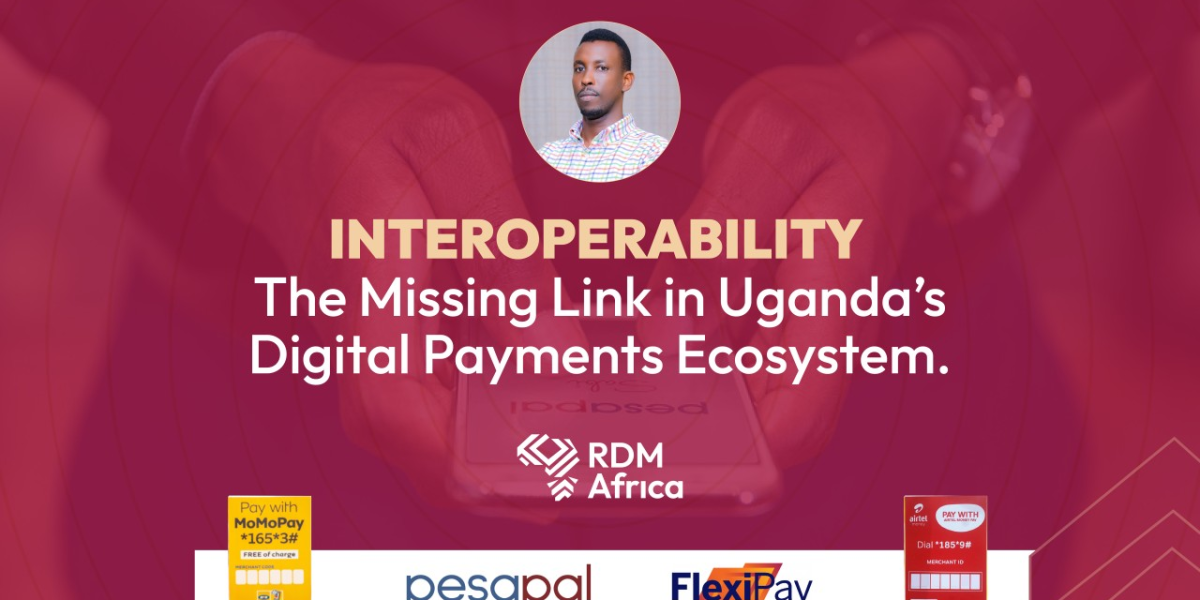
Uganda’s digital payments ecosystem is characterised by mobile money platforms, online payment gateways, and increasing adoption in the retail and service sectors. Mobile money is widely used, digital payment rails are expanding, and fintech solutions are gradually finding their footing. Digital payments represent a unique transformative opportunity to break free from the dominance of cash across Uganda and Africa. Players such as MTN MoMo Pay, Airtel Money, Stanbic FlexiPay, Wendi, Pesapal, among others, dominate the market, with banks and fintech companies providing supplementary solutions. The growth in recent years is fuelled by technological advancements, increasing smartphone adoption, and expanded internet access. While these systems cater to thousands of users, the market remains fragmented and reliant on a limited pool of active merchants to process transactions effectively. This poses a significant challenge: unless a digital finance service provider meets the one million merchants target, all actively transacting, their prospects for sustainable scalability remain uncertain. The most reliable and cost-effective solution to this – tried and tested in more developed markets – is interoperability. Interoperability is the ability of different digital payment platforms, systems, or networks to communicate and transact seamlessly. Imagine a system where users on MTN MoMo Pay, Airtel Money or FlexiPay can pay for goods and services to a single merchant code. Where a business accepts payments from multiple wallet providers through a single interface. That’s the future we should be working towards.
A broader merchant base would ensure that digital payment systems become entrenched in everyday commerce, reducing reliance on cash and strengthening financial inclusion.

Opportunities for Growth

While mobile money payments are currently the most viable alternative to cash dominance in the African market, innovations from banks, unit trusts, and other digital finance players become more fluent in the language of convenience with every new release. A sign that you cannot count them out of this race just yet. Uganda’s burgeoning fintech industry offers immense opportunities. With a youthful population increasingly reliant on smartphones, there is a ready market for digital payments. Furthermore, government initiatives aimed at promoting cashless transactions, like the Central Bank’s shift to digital currency to cut costs, coupled with rising e-commerce trends, provide fertile ground for cultivating a robust merchant base.

Challenges Faced

  1. Lack of interoperability
The payments industry in Uganda and across Africa is increasingly complex and fragmented into small territories owned by individual players i.e., MTN MoMo pay, Airtel Money Pay, Pesapal among others. Customers hold multiple phones, one with an Airtel line, or MTN line, in addition to multiple wallets for purchase of transactions. This hinders existing wallet users from using these services at merchants where another wallet is accepted. It’s also an inconvenience to the merchants who must display multiple codes from MTN MoMo Pay, Airtel Money Pay, FlexiPay, Pesapal, etc. Payment players, however, are hesitant to adopt interoperability due to concerns of losing market share, at the cost of stifling a cohesive financial system. Embracing interoperability could enhance financial inclusion, reduce transaction costs, and create a seamless payment experience for users and merchants alike. India’s success in implementing interoperable payments serves as a blueprint for East Africa. By adopting a similar unified system, such as UPI, payment providers in Uganda and neighbouring countries can overcome barriers like limited accessibility and fragmented systems.
  1. Limited Merchant Adoption
One of the primary barriers is the slow adoption of digital payments by small and medium-sized businesses (SMEs). Many merchants still prefer cash transactions due to concerns over transaction fees, technology literacy, and trust in digital systems. Without a critical mass of merchants offering digital payment options, consumer adoption stagnates, and the cycle of growth is hindered.
  1. Lack of Incentives for Merchants
Merchants often require compelling incentives to transition from cash to digital payment systems. While some platforms offer promotional deals or reduced fees, these efforts have yet to yield significant widespread adoption among merchants.
  1. Consumer Trust and Awareness
Building consumer confidence to use digital payments consistently requires more robust security measures and awareness campaigns. Merchants often hesitate to adopt these systems if consumers show reluctance to use them.
  1. Need for Swifter Payment Tactics
The various players in the digital payments space ought to embrace contemporary technology, in the form of nascent tactics of transacting, to quicken payments. For example: QR code scan payments and the Tap & Pay method, to replace the multistep USSD code payment option which is most prevalent.
  1. Merchant Service Pricing Not Clearly Defined
For certain payment industry players, merchant service pricing is not capped. In all the three countries, the acquiring bank or digital wallet providers levy charges ranging from around 1–4%. While large business set-ups can absorb this cost, small businesses with low profit margins tend to pass on the commission cost to consumers. This, in turn, puts a burden on the merchant and reduces the incentive to use cards at the POS.
  1. The Know Your Customer (KYC) requirements
To overcome the challenges and reach the milestone of one million active merchants, stakeholders in Uganda must adopt a multi-pronged approach:
  • Strategic Partnerships: Collaborations between fintech companies, mobile operators, and government bodies can expand outreach programs and subsidize the costs of onboarding merchants.
  • Merchant Education: Training programs targeting SMEs should focus on the benefits of digital payments, including increased security, reduced cash-handling risks, and enhanced customer convenience.
  • Infrastructure Development: Expanding internet connectivity to underserved regions and reducing costs for digital payment devices is crucial.
  • Incentive Structures: Platforms could offer cashback, discounts, or reduced transaction fees to encourage merchants to adopt digital systems.
  • Data Analytics: Leveraging data insights to understand merchant behaviour and optimise services will build confidence and tailor solutions for varying business needs.


In Summary

The growth of digital payments in Uganda hinges on reaching a critical mass of one million active merchants. This milestone is not just a numerical target, it represents the tipping point at which digital payments will penetrate deeper into various sectors of the economy, promoting financial inclusion and economic resilience. By addressing existing challenges and capitalising on opportunities, Uganda can transform its digital payment ecosystem into a thriving, sustainable model for the future. These insights are drawn from our experience in launching merchant payment solutions across Africa, in Nigeria, Lesotho, Cote d’Ivoire, Mozambique, South Sudan, Sudan, and Uganda. DM Africa (Rural Digital Media) is a management consulting firm, with a speciality in Digital Finance Services, that leverages digital tools to deliver practical, forward-thinking solutions for businesses expanding into rural and peri-urban markets. We focus on empowering last-mile communities, creating inclusive growth, and unlocking grassroots potential.
Share:

Let’s work together

Get in touch
Headquarters - UG

Plot 86, Luthuli Avenue, Bugolobi, Kampala – Uganda
+256 393 100167 | +256 763 948599

Where we have been

Uganda, Nigeria, Lesotho, Mozambique, Cote d’Ivoire, Sudan, South Sudan and Botswana

RDM Africa is a management consulting firm that leverages digital tools to deliver practical, forward-thinking solutions for businesses expanding into rural and peri-urban markets across Africa.

© 2026 RDMAfrica All right reserved.